亚马逊
福鼎西澳村:让渔村更像渔村_我的网站

A |
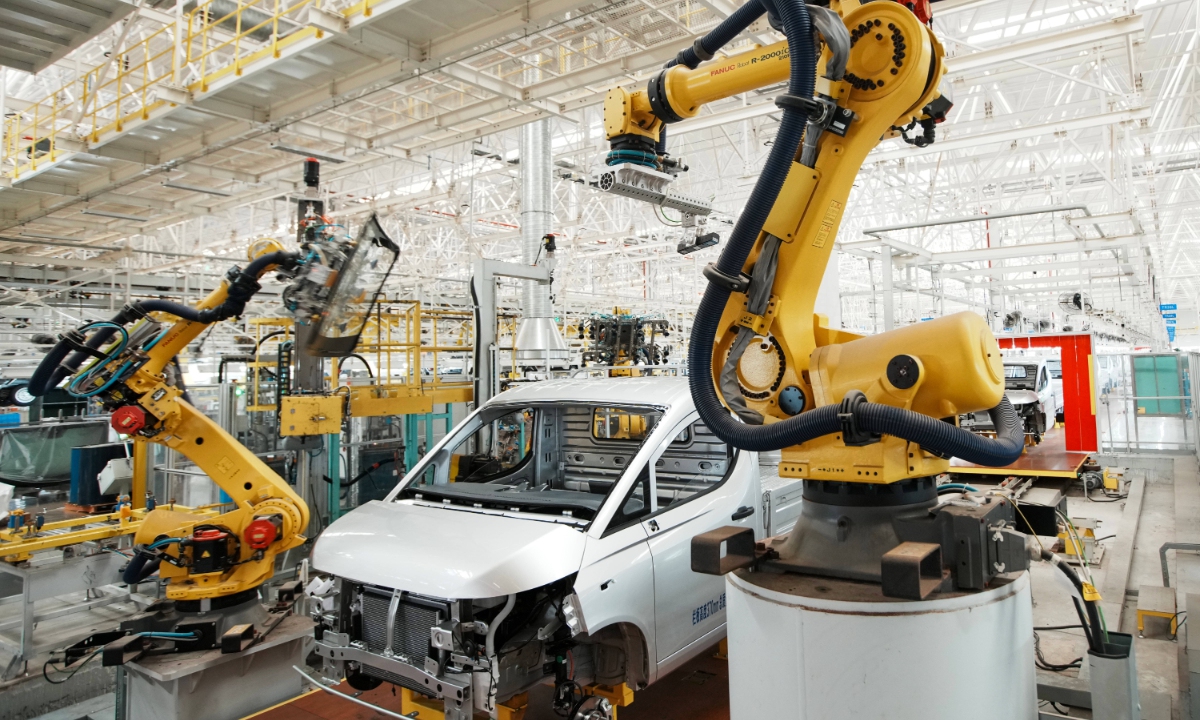
Robots assemble a new-energy passenger vehicle at Liuzhou Wuling Automobile Industry Co in Liuzhou, South China's Guangxi Zhuang Autonomous Region, on July 18, 2026. Photo: VCG
China's auto exports maintained strong growth in July, with shipments exceeding 1 million units for two consecutive months in June and July, according to the China Association of Automobile Manufacturers (CAAM) released on Wednesday, and new-energy vehicle (NEV) exports were particularly strong.
The latest data show that China exported 1.043 million vehicles in July, up 0.6 percent month-on-month and 81.3 percent year-on-year. Auto exports had already exceeded 900,000 units in both April and May, before rising above 1 million units in both June and July.
Notably, NEV exports were particularly upbeat. China exported 553,000 NEVs in July, up 5.7 percent month-on-month and 145.5 percent year-on-year. NEVs have accounted for more than half of China's total auto exports for two consecutive months.
The rapid growth in China's auto exports is mainly attributed to the country's complete automotive industrial chain, the CCTV News reported, citing a representative with the CAAM. From lithium processing and battery manufacturing to electric motors, control systems and vehicle assembly, China has sufficient production capacity, competitive costs and a highly resilient supply chain, said the representative.
The continued growth in NEV exports reflects rising global demand for cost-effective Chinese products and the needs of the global green transition, Cui Dongshu, secretary-general of the China Passenger Car Association, told the Global Times on Wednesday, noting that China's highly coordinated NEV ecosystem enables faster technological and product upgrades while keeping costs under control, giving the industry a key competitive edge.
Among China's top 10 auto exporters, Chery exported 1.141 million vehicles in the first seven months of the year, up 71 percent year-on-year and accounting for 18.6 percent of total exports. Tesla recorded the fastest growth from a year earlier, with exports reaching 295,000 units, up 130 percent, according to the CAAM.
"Despite rising trade barriers in the US and Europe, China's NEV exports continue to grow rapidly, reflecting strong global demand. Trade restrictions may shift export flows, but cannot easily curb demand for competitive products," said Cui.
Meanwhile, Chinese NEV companies are diversifying its markets, with regions such as Southeast Asia playing a growing role.
The domestic market remained the largest market for NEVs. In the first seven months, NEVs accounted for 53.2 percent of domestic auto sales, according to the CAAM.
The booming demand for China-made NEVs at home and abroad also rebuts the "overcapacity" narrative pushed by some Western media and politicians, as facts and figures show that demand is outpacing supply, Cui said.
An official from China's Ministry of Commerce told a press conference on July 28 that China has the world's largest consumer market, providing a testing ground for new technologies, products and services. The country has ranked first globally in NEV sales for 11 consecutive years.
China has built a complete and highly efficient NEV industrial system covering the entire chain, from basic materials and auto parts to complete vehicles and manufacturing equipment, with globally leading supply chain responsiveness, cost control and delivery speed.
"A complete, efficient and innovative automotive ecosystem is the result of long-term market competition and industrial development... It cannot be easily replicated in the short term or weakened by tariffs and trade barriers," Cui said.
The industry veteran said that looking ahead, China's NEV competitiveness will increasingly be measured not just by exports, but by the global presence of its companies, technologies and supply chains, as domestic automakers shift from mainly exporting vehicles to building production, supply chains and service networks overseas.
。

B | AI摘要
福鼎西澳村通过升级养殖设施、延伸加工冷链链条、完善基础设施及融合文旅文创,2025年渔业产值破亿元。该村坚持集体主导,实现产业现代化与村民共同富裕。

C |
东南网8月21日报道(福建日报记者 庄然 通讯员 王婷婷)初秋,清晨5点,福鼎市沙埕港的海风扑面而来,龙安街道西澳村渔民廖书登的运输船缓缓靠岸,甲板上堆满刚从海上捕捞上来的渔获。

D | 岸上,同伴忙着接驳卸货,热闹声顺着海风散开,拉开新一天的丰收序曲。 谁能想到,这个常住人口不足千人的小渔村,2025年渔业总产值突破1亿元。 “我们村有着400多年历史,传统渔业根基深厚,现代渔业也是近些年才发展起来的。”西澳村党支部书记林振烛把家乡历史娓娓道来。 西澳村小海捕捞始于20世纪60年代。20世纪80年代,渔民们发明了“围缯船”——两条船配合撒网捕鱼,成为当时最先进的作业方式。 2007年,村里木质网箱全面铺开,每口网箱产量比传统捕捞翻了5倍。

E | 2018年,随着新型深水抗风浪塑胶网箱改造全面铺开,网箱深度从3米增至10~15米,养殖容量大幅提升。 “之前养鱼容易受天气等因素影响,换了新型网箱,抗风浪、抗海流能力更强了。”养殖户林振茂指着海面上整齐排列的新型网箱说。他的养殖场如今年产值已超过百万元。

F | “当年卖”是当地积累财富的奥秘。 在西澳村,没有“囤货”的概念。每当渔船靠岸,活鲜直接被等候的收购商运走。“最大头的大黄鱼养殖,我们都是当年卖。”林振烛说。

G | 产业链的延伸,是西澳村再上新台阶的关键。

H | 在村内的虾皮加工厂里,工人们正忙着筛选、打包,一箱箱5公斤装的虾皮将发往山东等地。“8至9月份是旺季,十几名工人日结工资。”林振烛说。 8月初,总建筑面积超3000平方米的冷链仓储体项目正式投用。

I | 制冰厂负责人林元整介绍:“一艘船载重100吨,以前渔民要穿棉袄手工碎冰,现在有了碎冰机和冷库,不仅保鲜品质提升,还创造了十几个就业岗位。

J | ”
基础设施的完善,为渔村产业链闭环提供了坚实支撑。投资建设的三级渔港码头即将验收,这片2亩多的公益性码头,配合规划中的400亩产业园,正吸引闽威等龙头企业接洽入驻。 “等码头投用后,将彻底打通渔获上岸的‘最后一公里’,也能带动村集体、村民双增收。”林振烛给记者算了一笔账,仅海域使用金和冰库租金两项,村集体年收入就超过50万元。未来,这里将形成“养殖—捕捞—加工—储存—运输”的现代化渔业集群。

K | 而今,产业的硬实力与文化的“软植入”正在西澳村交相辉映。

L | 日前,中央美术学院大二学生王怀博利用暑期10天实践,带着10名同学为村子设计了整套视觉系统。 文创空间“厝边头尾”(当地方言,“邻里”之意)里,以渔村养殖的大黄鱼为原型的IP“笑仔”憨态可掬,吸引着游客驻足,西澳村正以“渔旅相融”的姿态,将“海味经济”从养殖销售延伸至文化消费领域。

M | 站在村口新建的沥青路上,林振烛回忆起10年前的模样:“那时候连条像样的路都没有,年轻人全往外跑。”眼下,全村八成劳动力从事渔业相关产业,平均工资比周边乡镇高出不少。更难能可贵的是,村里始终保留着集体经济的主导权——海域使用权统一管理,码头等基础设施由村经合社运营,收益反哺公共服务。 “乡村振兴不是要把渔村变成城市,而是要让渔村更像渔村,同时让渔民过上城里人的生活。

N | ”林振烛说这话时,远处传来机器的轰鸣声。那是新码头的施工声,也是西澳人奔向共同富裕的脚步声。
Current article:http://v45.gamajionghuanmuniuzhuanguchu.cyou/news/20260826_165.html
Published on:08:26:38